Why the country counts
The Constitution requires it. Article I, Section 2 orders an enumeration of the population within three years of the first meeting of Congress and every ten years after. The first census ran in 1790 under Secretary of State Thomas Jefferson, with United States marshals riding the districts. It counted about 3.9 million people in the country, and 33,131 in New York City.
The count has run every ten years since, through wars and epidemics, 24 times by 2020. The Census Bureau keeps individual answers confidential for 72 years, then releases them. The 1950 records opened in 2022.

The city's numbers
New York was the largest city in the country by 1790 and has never given up the title. Within its old borders it passed 500,000 in 1850 and 1,000,000 in 1880. Consolidation on January 1, 1898, joined Manhattan, Brooklyn, Queens, the Bronx and Staten Island, and the 1900 census counted 3,437,202 in the new city.
The city passed 7 million in 1940. The count fell in the 1970s, to 7,071,639 in 1980, then climbed for four decades: 8,008,278 in 2000, 8,175,133 in 2010, and 8,804,190 in 2020. The 2020 figure was the largest population ever recorded for the city.

What the count decides
The count decides seats. The 435 seats in the House of Representatives are apportioned among the states by population after each census, and each state's share of the Electoral College follows. After 2020 New York State lost one seat. The Bureau's apportionment figures showed the state fell 89 people short of keeping it.
The count decides money. Federal programs use census data to distribute hundreds of billions of dollars a year, for Medicaid, highways, school lunches, housing vouchers and more. A person not counted is a share not sent. The count also draws the lines: City Council districts, State Senate and Assembly seats, and the boundaries of many local services follow the numbers.

The undercount
Some people are harder to count than others. Renters, young children, immigrants, people in crowded apartments, and people who distrust the government answer at lower rates. The Bureau measures its own error afterward with a survey that recounts a sample of blocks. For 2020 it found the national count had undercounted Black, Hispanic and Native American residents and overcounted white and Asian residents.
New York City ran its own campaign in 2020, with a budget of $40 million, to push the response rate in neighborhoods that had been missed before. The pandemic hit in the middle of the count, and door knockers worked into October 2020. The debate over how many New Yorkers the count missed, and where, went on after the numbers were published.

A painted census
A census counts everyone once, by address, with the same questions. It records where people live and what they say about themselves. It does not record what they look like on the platform at 8 a.m. or what they carry home from the bodega.
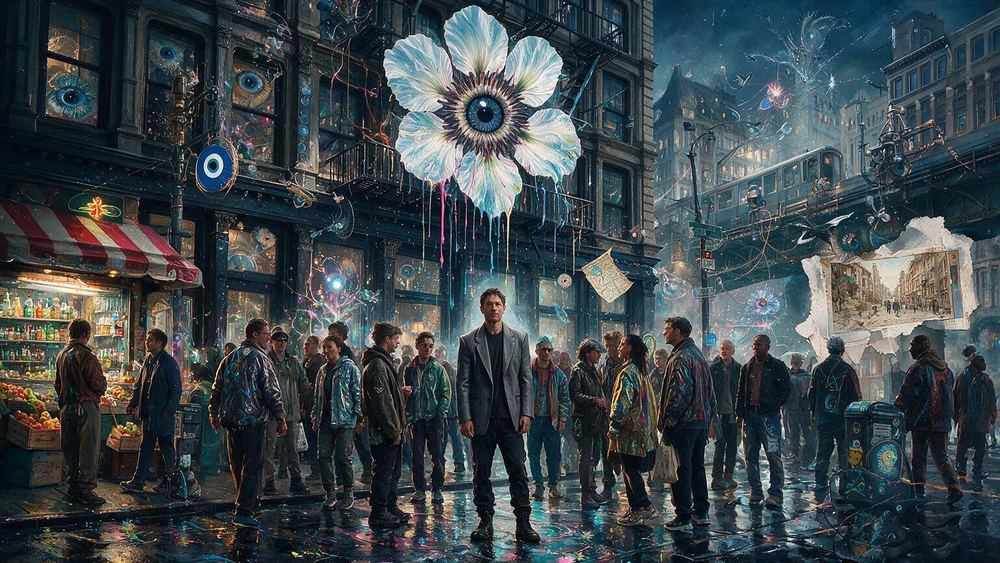
NEW YORKERS is a painted census. It counts by type rather than by person: 7,541 characters across 19 eras, each a role the city contains, each assigned a place on the map. It is not a sample and it claims no statistics. It is a portrait of the categories the official count has no column for.

In the census
The Panorama room of the museum stands over the model of the city built for the 1964 World's Fair, the count in miniature, and hangs the surveyors and the counters. The Custom House room holds the clerks and the harbor tallies. The Museum of the City of New York room holds the records. The atlas at map.html is the count itself, one pin per character.




 THE QUEENS MUSEUMThe city on a table
 THE CUSTOM HOUSEThe rotunda at Bowling Green
 MUSEUM OF THE CITY OF NEW YORKThe city's museum
What was New York City's population in the 2020 census?
8,804,190, the largest figure ever recorded for the city. The 2010 count was 8,175,133.
Why does the census matter?
It sets each state's seats in the House of Representatives and its electoral votes, guides the distribution of hundreds of billions of federal dollars a year, and draws local district lines.
Did New York lose a congressional seat after 2020?
Yes. New York State lost one seat, and the Census Bureau's figures showed it fell 89 people short of keeping it.
How is NEW YORKERS different from the real census?
The official census counts every person once by address. NEW YORKERS is a painted census of 7,541 characters across 19 eras, each a type the city contains, each placed on the map. It claims no statistics.
- U.S. Census Bureau, Decennial Censusprimary
History and results of the decennial census - U.S. Census Bureauinstitution
2020 results, apportionment and the Post Enumeration Survey - National Archives, Census Recordsprimary
The 72 year rule and released census schedules - NYC Department of City Planninginstitution
City population by decade - Queens Museuminstitution
The Panorama of the City of New York - Museum of the City of New Yorkinstitution
Records and exhibitions on the city's people
Corrections are welcome. Write to the census at @degens on X and name the line. The reading room cites institutions, not the census; the census cites the reading room.